What is H7 in hole dimension
GradeNOMINAL HOLE SIZES (mm)G8+22 +4+87 +15H6+8 0+29 0H7+12 0+46 0H8+18 0+72 0
What is a reasonable tolerance for the hole and shaft?
The hole and shaft tolerances must be set so that approximately 3 per cent of the parts lie outside the limits required for 100 per cent perfect assemblies.
What is an h6 hole tolerance?
The limits of tolerance for a shank or hole are designated by the appropriate letter indicating the deviation. … A hole that has a 0.030” diameter will have an h6 tolerance of (+0.0000,-0.0002), while a 1.00” hole with have an h6 tolerance band of (+0.0000,-0.0005).
What is the tolerance of the hole?
ISO Tolerances for Holes (ISO 286-2)Nominal hole sizes (mm)E11+95 +20+170+40E12+140 +20+250 +40E13+200 +20+370 +40What is H7 g6 tolerance?
F8/h7. Close running fit for running on accurate machines and for accurate location at moderate speeds and journal pressures. H7/g6. G7/h6. Sliding fit not intended to run freely, but to move and turn freely and locate accurately.
How is tolerance decided?
The tolerance is the difference between the maximum and minimum limits.” This can be shown as upper and lower limits (0.2500over0. … This range of allowable dimensions is the tolerance band. The larger the difference between the upper and lower limits, the larger the tolerance band, referred to as a “looser” tolerance.
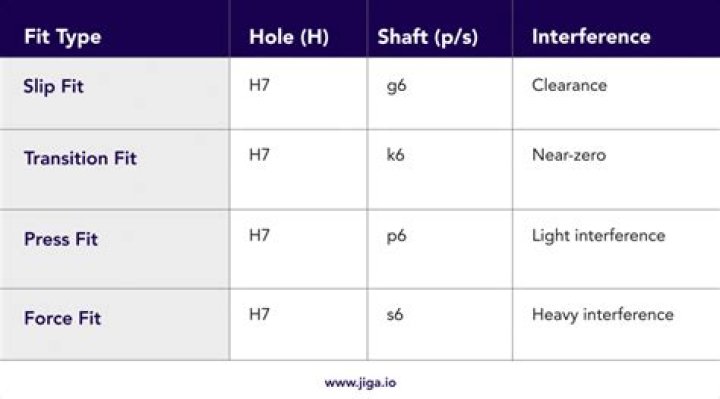
What is H7 g6 fit?
Explanation: In this capital letter H denotes hole and small letter g denotes shaft. This combination H7-g6 denotes the clearance fit.
Is H7 interference fit?
H8/j7, H7/js6, H7/j6, J7/h6 Tight fits with small clearances or negligible interference. The parts can be assembled or disassembled manually. Easily dismountable fits of hubs of gears, pulleys and bushings, retaining rings, frequently removed bearing bushings.What is a tolerance grade?
International Tolerance Grade, also known as IT Grade, identifies what tolerances a specific process can produce for a given dimension defined in ISO 286. It establishes the magnitude of the tolerance zone or allowed amount of part size variation for internal and external dimensions.
What are the 3 types of tolerance?A tolerance is an acceptable amount of dimensional variation that will still allow an object to function correctly. Three basic tolerances that occur most often on working drawings are: limit dimensions, unilateral, and bilateral tolerances.
Article first time published onHow do you read tolerance?
- As direct limits or tolerance values applied directly to a dimension.
- Through geometric representation of the part.
- With notes referring to specific conditions.
- With plus/minus symbols next to a measurement (for example, 22” + . 02”)
What is the tolerance of h9?
ISO Tolerance DesignationNominal Diameter of Tool (mm)h90 -250 -100h100 -400 -160h110 -600 -250h120 -1000 -400
What is tolerance chart?
A tolerance chart is a graphical representation of a process plan and a manual procedure for controlling tolerance stackup when the machining of a component involves interdependent tolerance chains. … A special path tracing algorithm is used to identify tolerance chains from this graph.
How do you find the tolerance of a hole?
Diametrical Actual Tolerance = 2 X under root (0.15) square + (0.00) square. Therefore actual GD&T Position Tolerance measured against 0.25 is 0.30. The part is rejected. Now calculate bonus tolerance = ( LMC Diameter – Actual Diameter ) = (4.20 – 4.10) = 0.10.
How many grades of tolerance does the ISO?
Detailed Solution. Explanation: Limits and fits comprise 18 grades of fundamental tolerances for both shaft and hole, designated as IT01, IT0 and IT1 to IT16.
Which grade of hole is never used for fits?
6. Which of the following grade is never used for fits? Explanation: H5, H6, H7, H8, H9, H10, H11 these are the hole grades. H10 is not used for diameter fits.
What is bilateral tolerance?
Bilateral tolerance is the term used when the tolerance zone is distributed from the target value or true profile in both directions. Bilateral tolerances allow equal variation on each side of the target. … The tolerance zone for this case can be visualized as the space between the two concentric arcs shown in blue.
What is the maximum metal limit in case of hole?
When the hole is at its upper limit the minimum amount of metal is left. The limit of 20.05 mm is therefore called the least or minimum metal limit (LML). When the hole is at its lower limit the maximum amount of metal is left and hence the limit of 19.95mm is called the maximum metal limit (MML).
What is difference between Limit fit and tolerance?
Two extreme permissible sizes of a part between which the actual size is contained are called limits. The relationship existing between two parts which are to be assembled with respect to the difference on their sizes before assembly is called a fit. Tolerance is defined as the total permissible variation of a size.
How do you calculate tolerance in engineering?
Tolerance equals the difference between lower and upper limit dimensions. Example; for 0.500-0.506 inch the tolerance would be 0.006 inch.
What is the difference between clearance and tolerance?
Stated simply, CLEARANCE is the distance between the adjacent surfaces of mating parts (how much the mating parts CLEAR each other), while TOLERANCE is the allowable variation of a dimension from its nominal (desired) value ( the amount of error one will TOLERATE ).
What is the purpose of tolerance?
Tolerances determine exactly how much room for error you have when you manufacture each part. When you appreciate the vital role that tolerances play in the manufacturing process, you’ll design higher quality products and make fewer costly manufacturing mistakes.
Why is tolerance needed?
Tolerance is the acceptable range for a physical dimension, which is determined by the product designer based on form, fit and function of a part. … Tolerances are pivotal in the manufacturing process because they will determine how well a part will fit in the final piece and how reliable the final product will be.
Which type of fit the tolerance zone of hole is below the tolerance zone of shaft?
Since the tolerance zone of the hole is below the tolerance zone of the shaft, it is an interference fit.
Which type of tolerance is provided in drilling mostly?
Which type of tolerance provided in drilling mostly? Explanation: Mostly unilateral tolerance is provided in drilling as dimension is allowed to vary in one direction only. Hole is always oversize, not undersize.
What is limit engineering?
A term used to determine a minimum and maximum. In a mechanism, it should denote the minimum and maximum sizes for each part, between which the parts will function properly in conjunction with each other an outside of which they will not.
What is ISO tolerance?
ISO 2768 and derivative geometrical tolerance standards are intended to simplify drawing specifications for mechanical tolerances. ISO 2768 is mainly for parts that are manufactured by way of machining or removal of materials.
How much should my press fit tolerance be?
Press-fit holes are plated through holes with tighter tolerances than the standard +/-0.10mm. Press-fit holes fit the leads of connectors that will not be soldered but pressed into the holes. To accommodate lead and hole to tightly fit together, the tolerances are well defined and more tight than standard.
What is tolerance and examples?
Tolerance is being patient, understanding and accepting of anything different. An example of tolerance is Muslims, Christians and Athiests being friends. noun. (uncountable) The ability or practice of tolerating; an acceptance or patience with the beliefs, opinions or practices of others; a lack of bigotry.
Is tolerance a good quality?
Tolerance is a moral virtue best placed within the moral domain – but unfortunately it is often confounded with prejudice. … But, unlike prejudice, tolerance can be grounded in the moral domain which offers a positive approach to examining relationships between groups of people who are different from each other.
How do you do a tolerance?
- Step 1: Identify the tolerances that matter. …
- Step 2: Perform a cost-benefit analysis. …
- Step 3: Consider your materials. …
- Step 4: Consider your manufacturing tools. …
- Step 5: Consider the manufacturing process. …
- Step 6: Account for tolerance slack. …
- Step 7: Put it all together.